Regional Planning
Regional Planning is guided by an overall vision or concept of what makes a place great? It is an expression of possibility; it reflects what people want to see happen in their community; now and in the future. The purpose of the Rutland Regional Plan is to provide a guide for managing change within the Region and a framework within which individuals, businesses, and local governments can make decisions regarding land use areas planned for conservation or growth.

Contact Our team for personal assistance

Three Years, 27 Towns, One Shared Plan
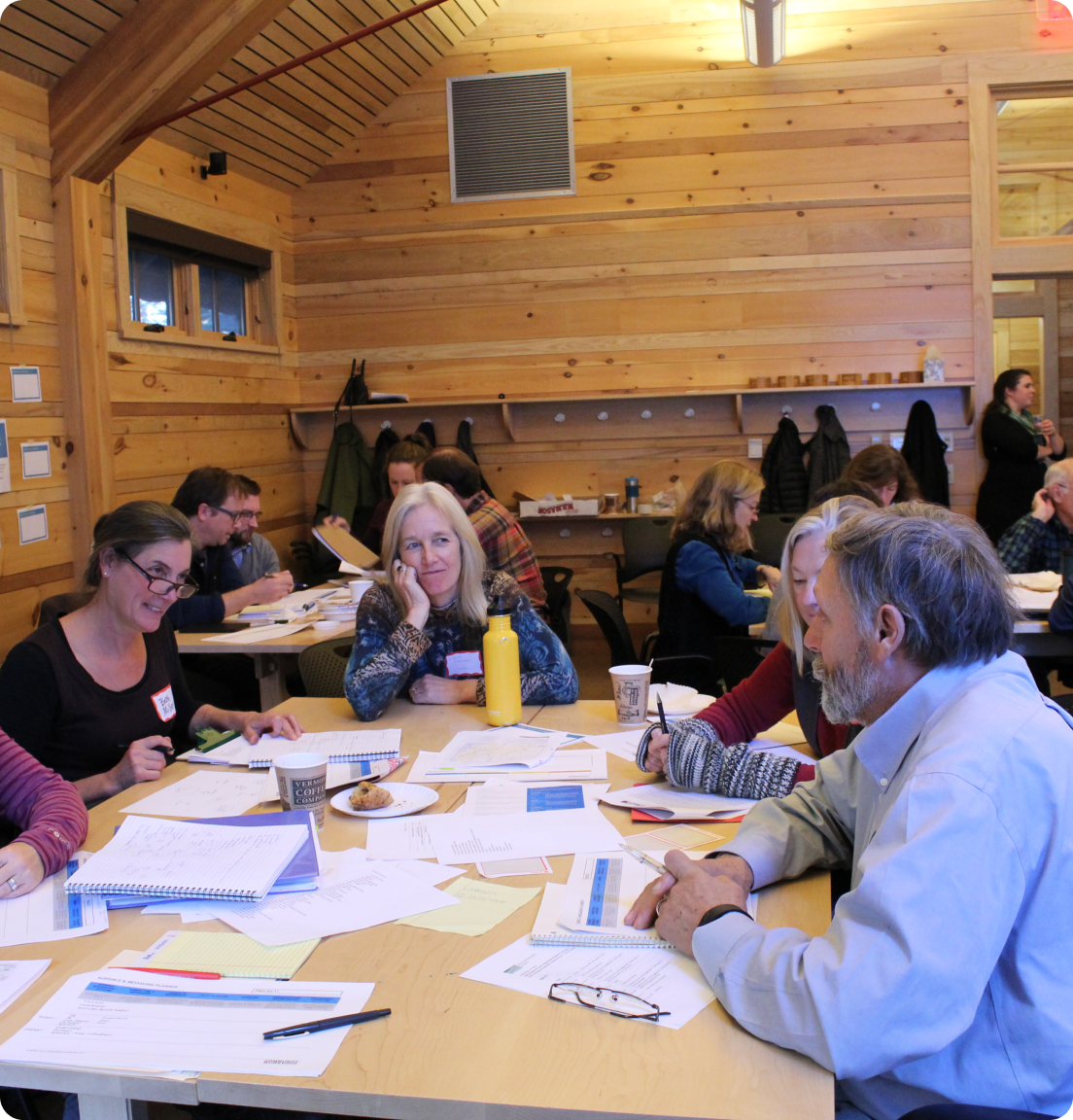
The RRPC began updating the Rutland Regional Plan in 2023. On May 19, 2026, the Plan was adopted by the RRPC Board of Commissioners – the result of five community workshops, dozens of pop-up conversations, and thousands of hours contributed by residents, local officials, and regional partners. It reflects what you told us. Thank you for showing up!
On July 17, 2026, the Public Service Department issued its determination that the Plan complies with the state requirements for enhanced energy planning.
On July 30, 2026, the Land Use Review Board approved the Plan and the RRPC’s Tier 1B area status requests for seven towns.
Learn more about why both approvals matter in the Implementation Section below.
Tier 1B Areas Approved
Fair Haven
Killington
Mendon
Poultney
Proctor
West Rutland
The Regional Plan
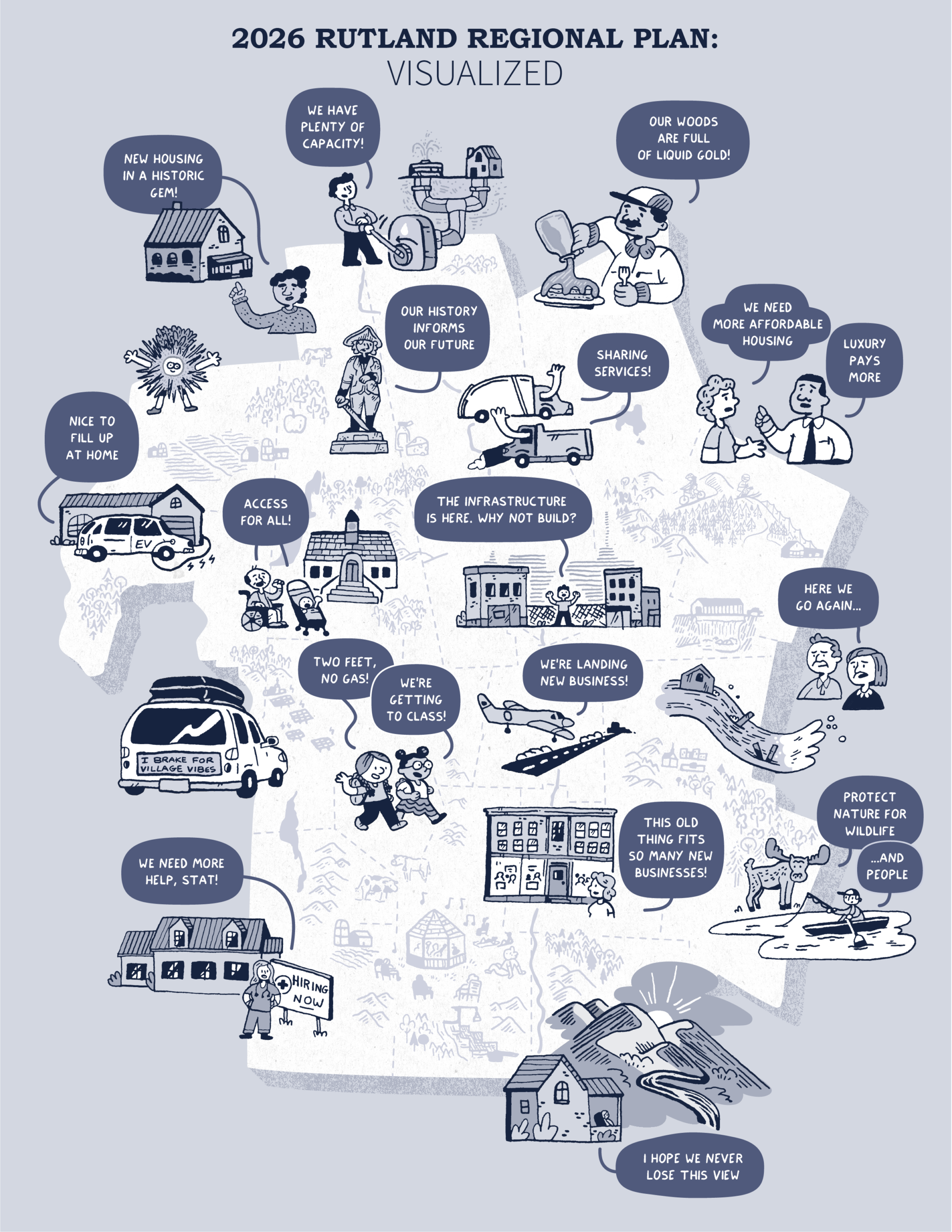
The Rutland Regional Plan outlines strategies for achieving our collective goals to achieve coordinated and efficient community economic development in a way that results in healthy, equitable, and resilient communities. At the core of this planning effort is an analysis of current land use and the identification of areas designated for future growth and conservation. Consequently, the various chapters are intended to coordinate with the Land Use Chapter and with one another.
The Thirteen Chapters
Chapters 2–11 share one format
- An Introduction with a statement of the planning goal
- A Healthy, Equitable, Resilient Communities section that describes how these themes apply to the chapter
- A description of current conditions, informed by engagement and regional data, which illustrates how local strengths, assets, and challenges influence community economic development
- A description of desired future conditions, informed by engagement and regional data, with trends that identify drivers of change, inform decision-making, and signal when to act
- A Policies, Actions, and Indicators section with clear and concise regional policy statements for how to achieve the planning goals, realistic actions for the RRPC, and measurable indicators to monitor progress
Introduction
Land Use
Outlines the current land use patterns that shape the Region and prospective location, amount, intensity, and character of land uses for each future land use category shown on the Regional Future Land Use Map.
This chapter also defines what kinds of development constitute a “substantial regional impact”.
Economic Development
Describes the current economic landscape with respect to regional employers, wages, and workforce and trends shaping the future of economic development in the Region.
Cultural Resources
Offers a snapshot of the Region’s historic, archaeological, scenic, and cultural assets and how emerging pressures will influence their future.
Transportation
Outlines the current state of the Region’s multimodal transportation network and how future demographic shifts, economic changes, and environmental pressures are expected to significantly influence transportation needs and infrastructure.
Housing
Identifies regional housing needs to ensure an adequate supply of code-compliant homes and outlines opportunities for developers, municipalities, and the RRPC to meet the Region’s housing needs. This chapter includes the Regional Housing Targets by Town.
Community Facilities & Public Utilities
Explores how to plan for, finance, and provide an efficient system of diverse public facilities and services, including fire and police protection, healthcare, educational and vocational opportunities, public drinking water and sewer treatment, solid waste disposal, childcare, non-commercial recreational opportunities, and telecommunications.
This chapter defines the Regional Standards for Section 248a Siting of telecommunications facilities.
Enhanced Energy
Serves as the RRPC’s certified Regional Enhanced Energy Plan. It examines the current state of energy in the Region and establishes voluntary targets and pathways to reduce total energy use, lower greenhouse gas emissions, and increase renewable electricity generation by 2050.
This chapter defines the Regional Standards for Section 248 Siting of electric generation, storage, transmission, and certain gas facilities.
Working Landscape
Shines a spotlight on the Region’s agricultural and forest industries, why these sectors of the economy matter, and how to encourage and strengthen them in the future.
Natural Resources
Describes how the Region’s remarkable natural resources are the core of its landscape and rural identity and future trends impacting their future protection and management.
Climate Resilience
Looks at the current condition of climate resilience in the Region and future opportunities to put the Region in a stronger position to not only recover but also to thrive amid future challenges.
Prefer the whole Plan at once?
Regional Future Land Use Map
What the Map Does
The map serves as a guide for future land use decisions and plays a role in showing areas eligible for Tier 1 Act 250 jurisdiction and the State Designation Program. It uses 11 state-defined land use categories to show areas for growth, conservation, and other uses based on infrastructure, development patterns, and community input. It does not regulate land use or change local zoning.
Turning Vision into Action
The Rutland Regional Plan’s impact comes from the RRPC, municipalities, partner organizations, and the public actively using and implementing it – turning the Plan’s vision into action.
Read the Plan Implementation chapter to learn more about the main mechanisms that will bring the Plan to life.
The Plan serves a variety of users
Citizens & Landowners
Municipal Officials
Businesses & Developers
State Agencies
As part of their application review for major subdivision and development projects seeking an Act 250 permit, Act 250 District Environmental Commissioners must determine whether the project aligns with the goals and policies of the Regional Plan.
The Vermont Public Utility Commission must also evaluate, in its application review for electrical or gas transmission or generation projects seeking a Certificate of Public Good, whether the project unduly disrupts the orderly development of the Rutland Region as outlined in the Regional Plan.
As a statutory party to all Act 250 and Section 248 applications in the Rutland Region, the RRPC’s Board of Commissioners conducts development reviews in accordance with its adopted application review policy. The RRPC Regional Committee reviews proposed developments for a) their conformance with the goals and policies of the Regional Plan, b) their potential substantial regional impact, and c) orderly development in the Rutland Region. Check out our Boards & Committees page to learn more.
Indicators of Progress
A live dashboard of the measures behind the plan — housing production, permits, population, transportation, and conservation acreage — updated as new data lands.
To learn more about the rationale behind the Indicators of Progress check out the Plan Implementation Chapter
New homes needed in the Rutland Region by 2040
Planning Now, and Tomorrow